
 MOTION IN A PLANE
Projectile Motion Lab
Predict range, flight time and peak height; explore complementary angles and the 45° maximum-range condition in a free physics lab.
◷ 12 min↗
THE SIMULATION LIBRARY
Find your lab by subject, class or chapter. Open an experiment and its guided lesson.
MOTION IN A PLANE
Predict range, flight time and peak height; explore complementary angles and the 45° maximum-range condition in a free physics lab.
 OSCILLATIONS
Investigate T ≈ 2π√(L/g), small-angle motion, gravity and energy exchange in the pendulum simulation.
 OSCILLATIONS
Explore Hooke’s law, period, frequency and kinetic–potential energy exchange in a guided spring–mass simulation.
 GRAVITATION
Calculate circular satellite speed and period as altitude changes; explore the 400 km Earth-orbit example in the virtual lab.
 ELECTRICITY
Calculate V = IR, electrical power and the V–I relation in a free interactive DC resistor simulation.
 WORK
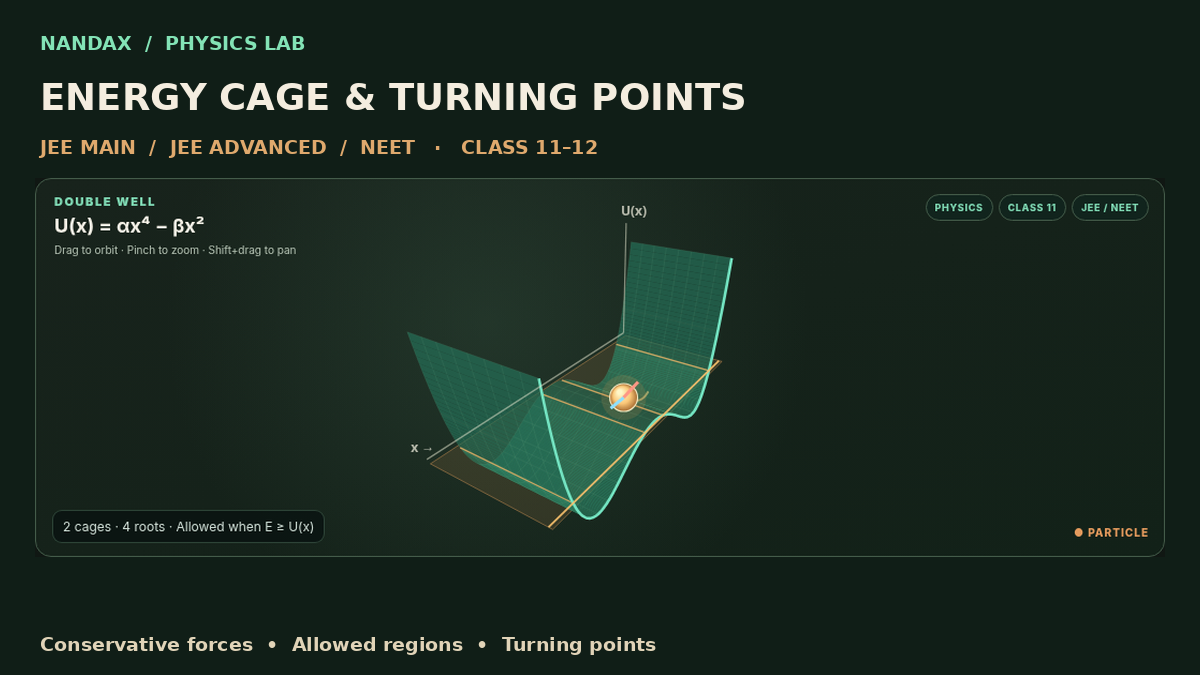
WORK
Explore potential energy, the energy barrier, classically allowed regions and turning points using harmonic, double-well and finite-well models.
 BODY FLUIDS AND CIRCULATION
Explore one simplified cardiac cycle with ventricular volume, pressure changes, valve states and cardiac output for NCERT and NEET.
 EQUILIBRIUM
Watch a reversible A ⇌ B reaction approach dynamic equilibrium and examine temperature shifts, reaction quotient and forward/reverse rates.
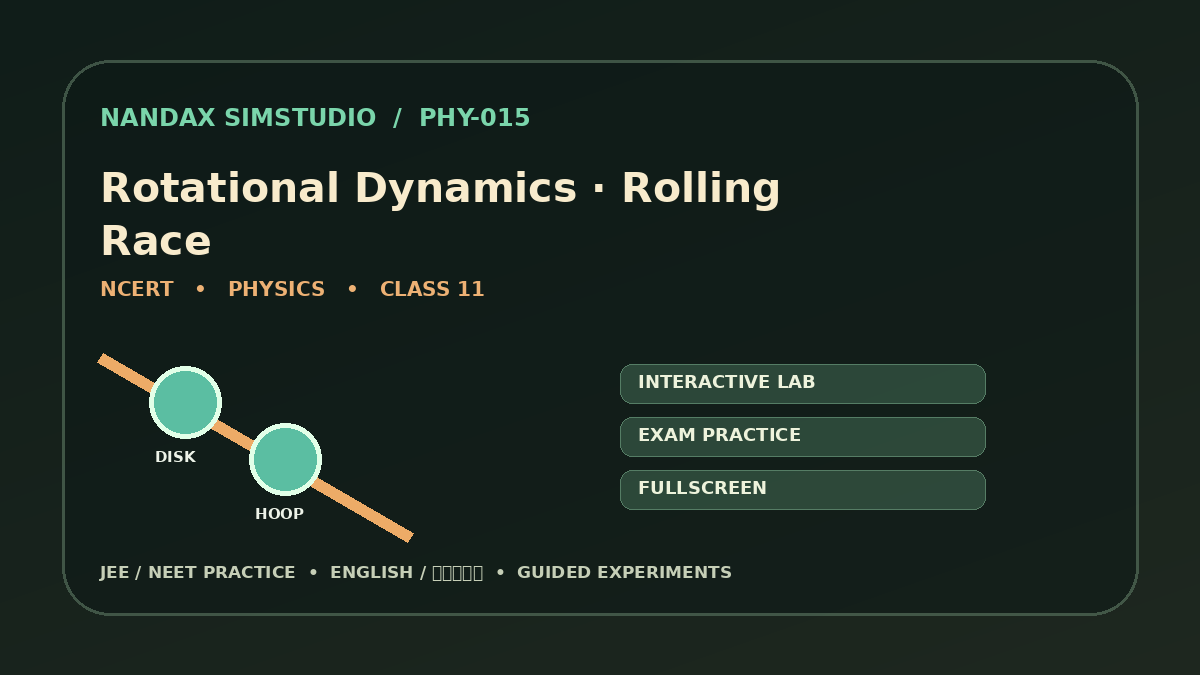 SYSTEM OF PARTICLES AND ROTATIONAL MOTION
Race a solid disk, thin hoop and solid sphere down an incline; investigate moment of inertia, static friction and energy partition.
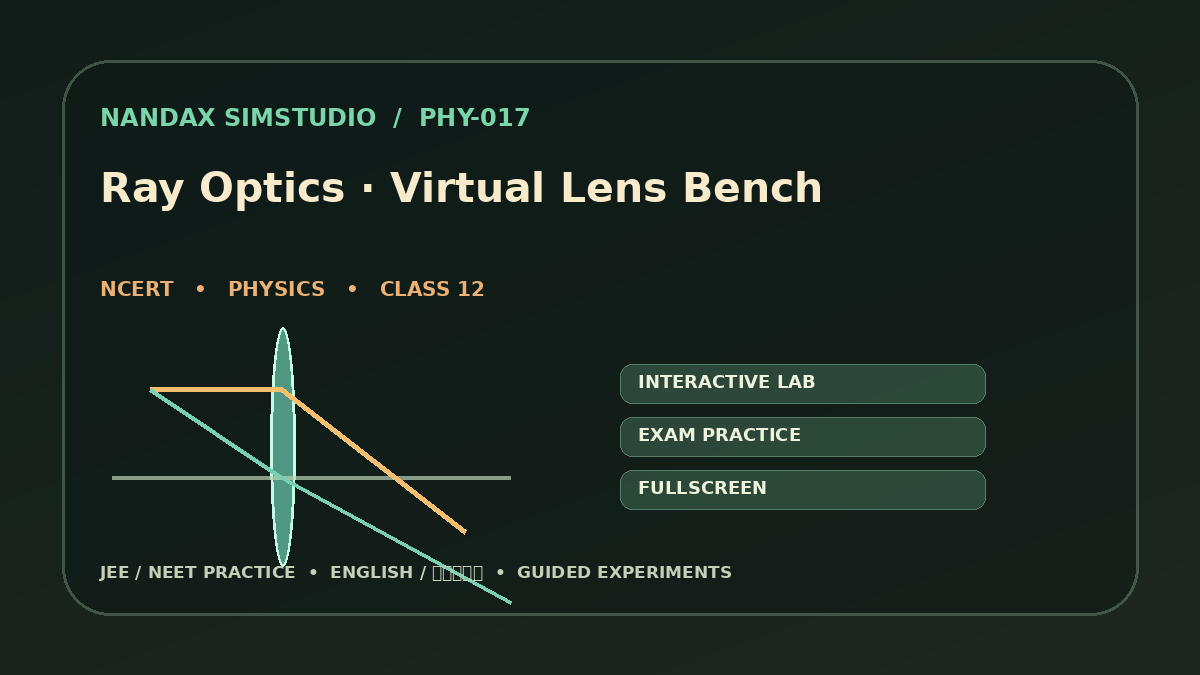 RAY OPTICS AND OPTICAL INSTRUMENTS
Build principal-ray diagrams and predict image position, orientation and magnification for convex and concave thin lenses.
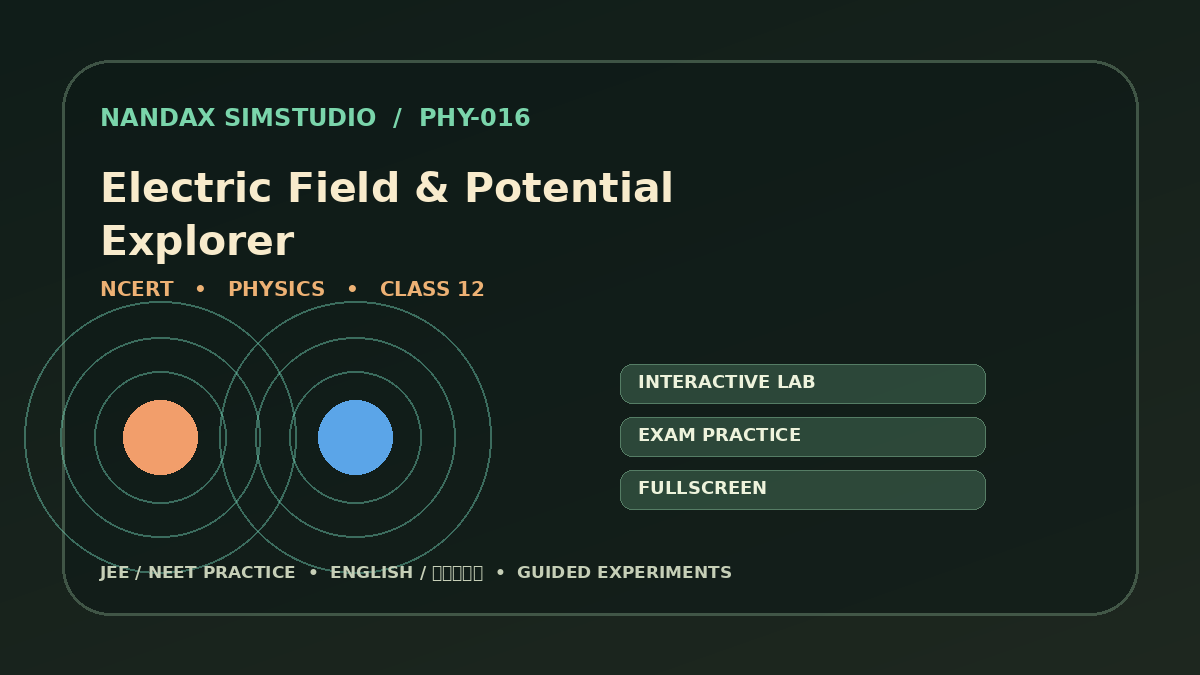 ELECTRIC CHARGES AND FIELDS
Map electric-field arrows, equipotential contours and a draggable probe for single, dipole and multi-charge arrangements.
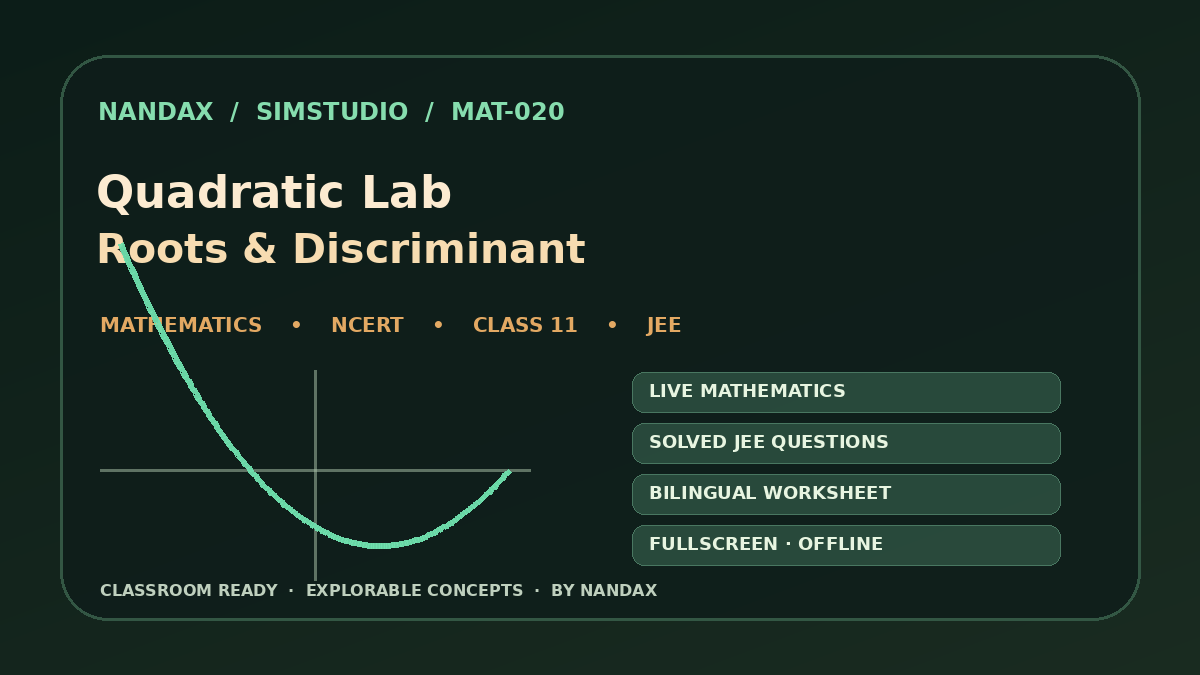 COMPLEX NUMBERS AND QUADRATIC EQUATIONS
Move the coefficients of a parabola and watch its vertex, axis, discriminant and real roots change in real time.
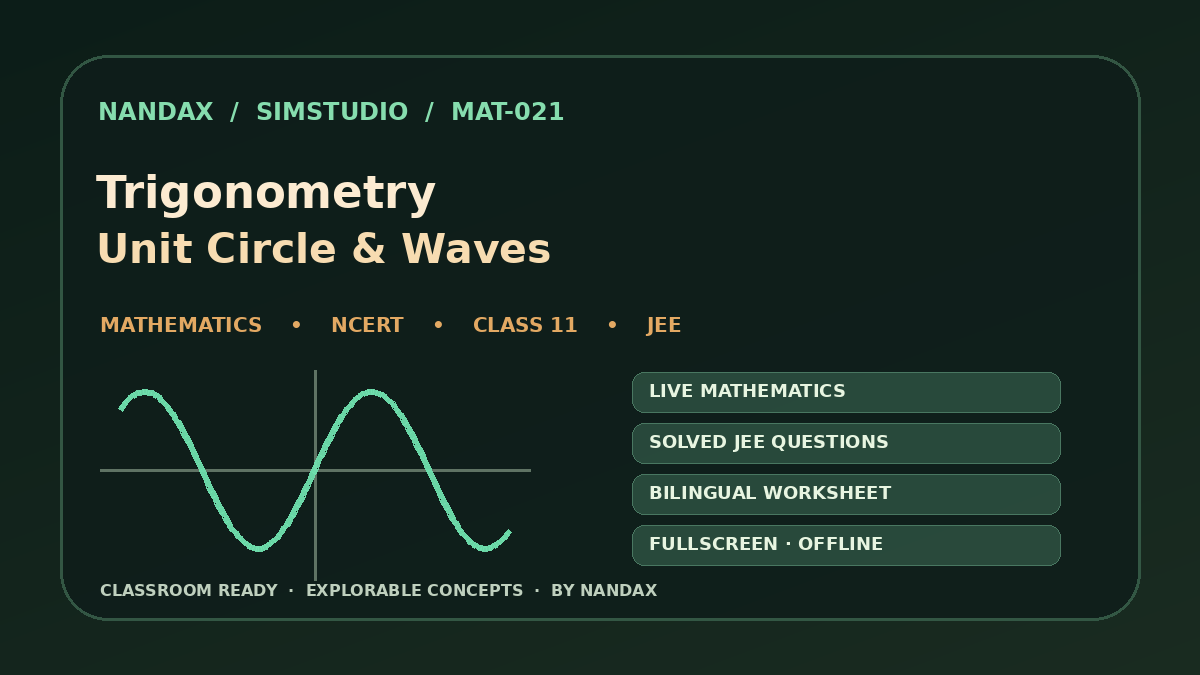 TRIGONOMETRIC FUNCTIONS
Link a rotating unit-circle radius to exact sine, cosine, quadrants, phase and frequency of their periodic graphs.
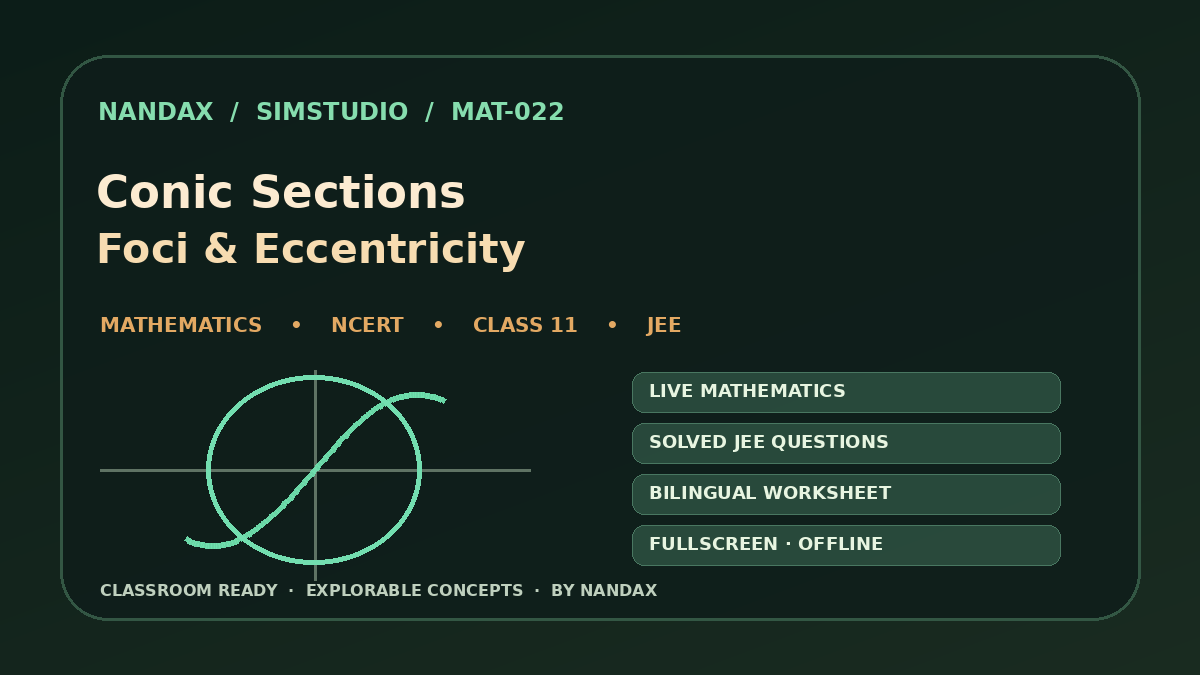 CONIC SECTIONS
Morph between an ellipse, hyperbola and parabola; study eccentricity, foci, directrices and standard equations on a dynamic coordinate plane.
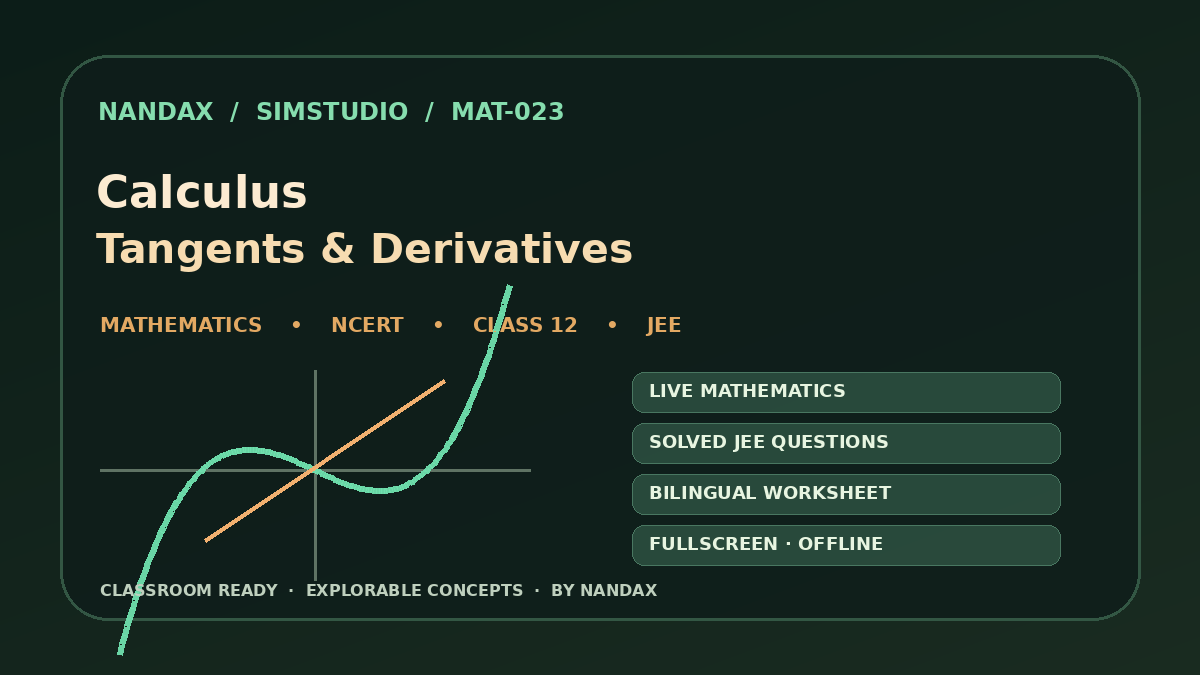 CONTINUITY AND DIFFERENTIABILITY
Drag the point of tangency, compare secant and tangent slopes, locate stationary points, and connect differentiation to optimization.
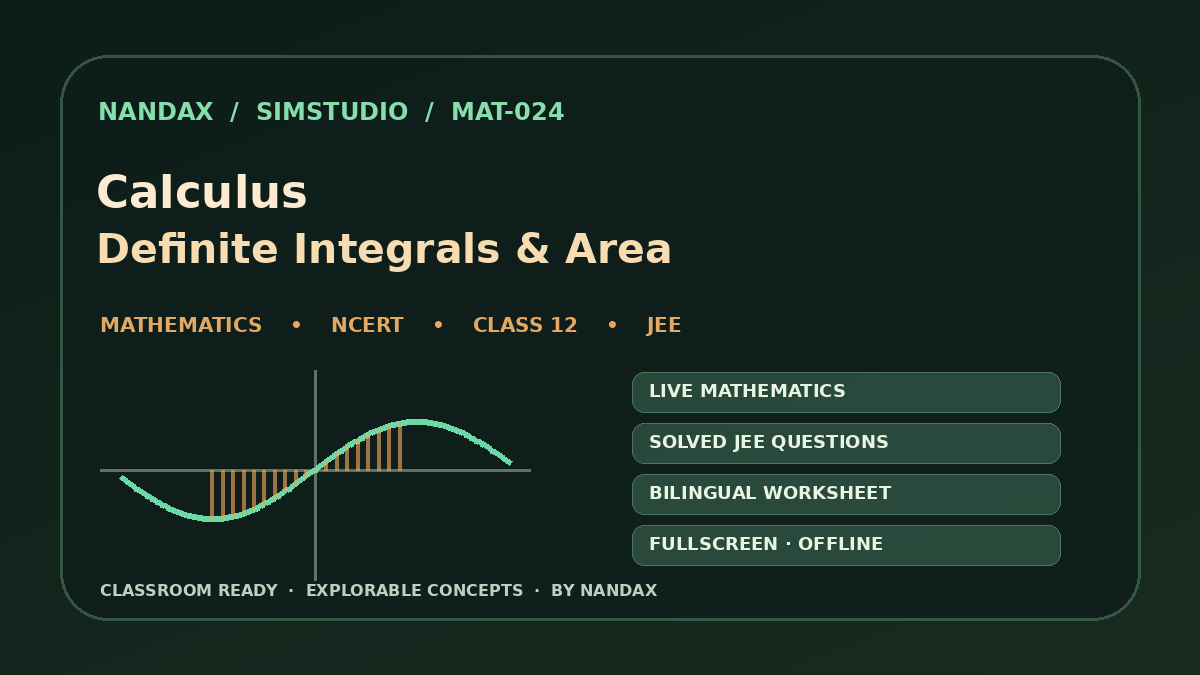 INTEGRALS
Shade signed area, compare Riemann sums with exact integration, and explore why negative regions subtract from a definite integral.
No matches. Try another class, subject, chapter or search term.